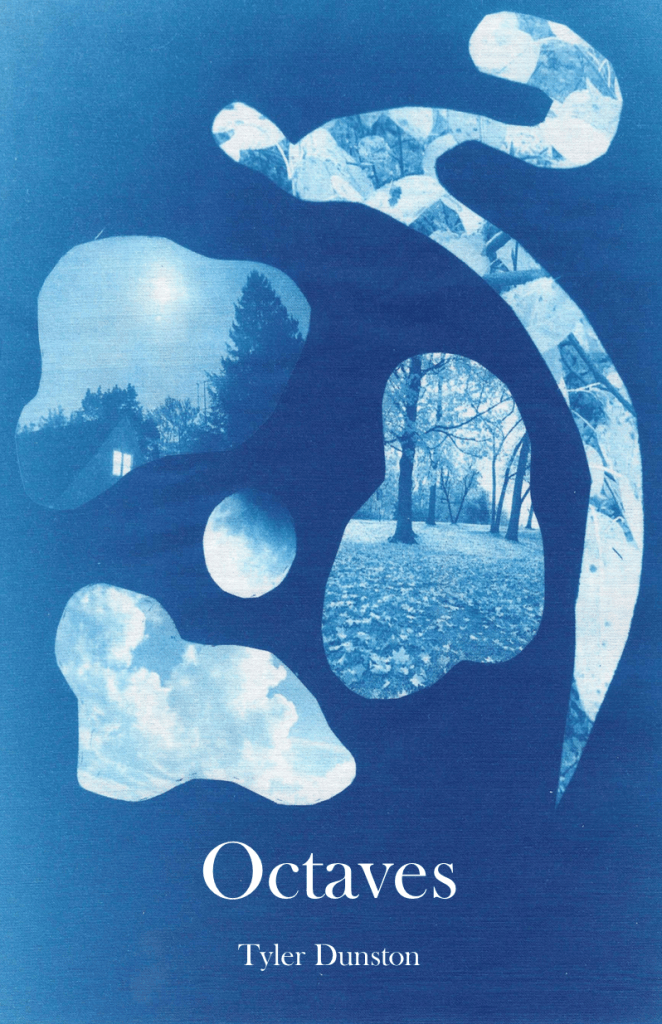
Octaves
Moonstone Press, 2025
Finalist for the Moonstone Press Chapbook Contest
Cover Art: Shannon Daniels
Praise:
“Tyler Dunston has written a book I will return to, and recommend to my friends, for its generous, lucid and attentive heart and its music of consonant and vowel within the eight-line format. The fresh imagining of landscapes and seascapes, international banks and lost coastlines, elegy and courtship befits the inventive poet whose new names for the nine muses include ‘burlap,’ ‘cuticle,’ ‘flask’ and ‘lodestar.’”
—Robert Pinsky
“Each short poem in Octaves is a glimpse, a guide, a way of seeing. A moment crystalizing even as it is receding. These poems present a past, and passing, world but they also insist on the present possible—the possibility of finding one’s way to a beloved in a nighttime city, the possibility of light filling a reservoir, the possibility of making art not as a balm but as a way of being alive. And these speakers are brightly alive, turning toward the world, looking for connection while facing the essential unknowability of another—’The awareness we feel…means nothing/nothing to pickerel frogs, or the night herons dipping their wings/in aqueous darkness as if they intend to paint. As for their reasons,/ how could I know?’ In a hundred years, when we return to these poems, to their haunted imagery and rare music, to their sure and clear-eyed search for meaning, their truths will be ones we recognize.”
—Brittany Perham
“As its title suggests, Tyler Dunston’s chapbook Octaves uses the constraints of its eight-line form to achieve a remarkable lyric compression and range of experience. These poems are starkly and resolutely solitary, but there is a daring here too: even the nine classical muses are renamed, and become ‘icepack, welkin, dove, lacunae,/ burlap, cuticle, bolter, hebridean,/ lodestar.’ And why should this not be so? Dunston’s acute sensitivity to nature even in urban environments, the precision of observation and grace of phrasing are impressive. ‘Whole universes turn on your axle,’ Dunston writes: they certainly do in this collection.”
—Karl Kirchwey
Press:

